Fieldproof
Run the real stack. Prove it before the field.
Fieldproof is a multi-domain robotics emulation and simulation platform. Ground robots (UGV), drones (UAV) and surface vessels (USV) run their unmodified ROS 2 (and bridged ROS 1) codebases inside isolated containers, fed by simulated sensors from a physics engine, orchestrated by a declarative scenario engine, and observed through a browser-based 3D cockpit. Every scenario is an automated test with pass/fail assertions, so field testing becomes verification of what already passed.
Status
Milestone M1 (the first scenario passes, in CI too) closed with v0.10.0; Phase 2, the scenario engine, is next. The status board is updated at the end of every working session; the roadmap lists the milestones.
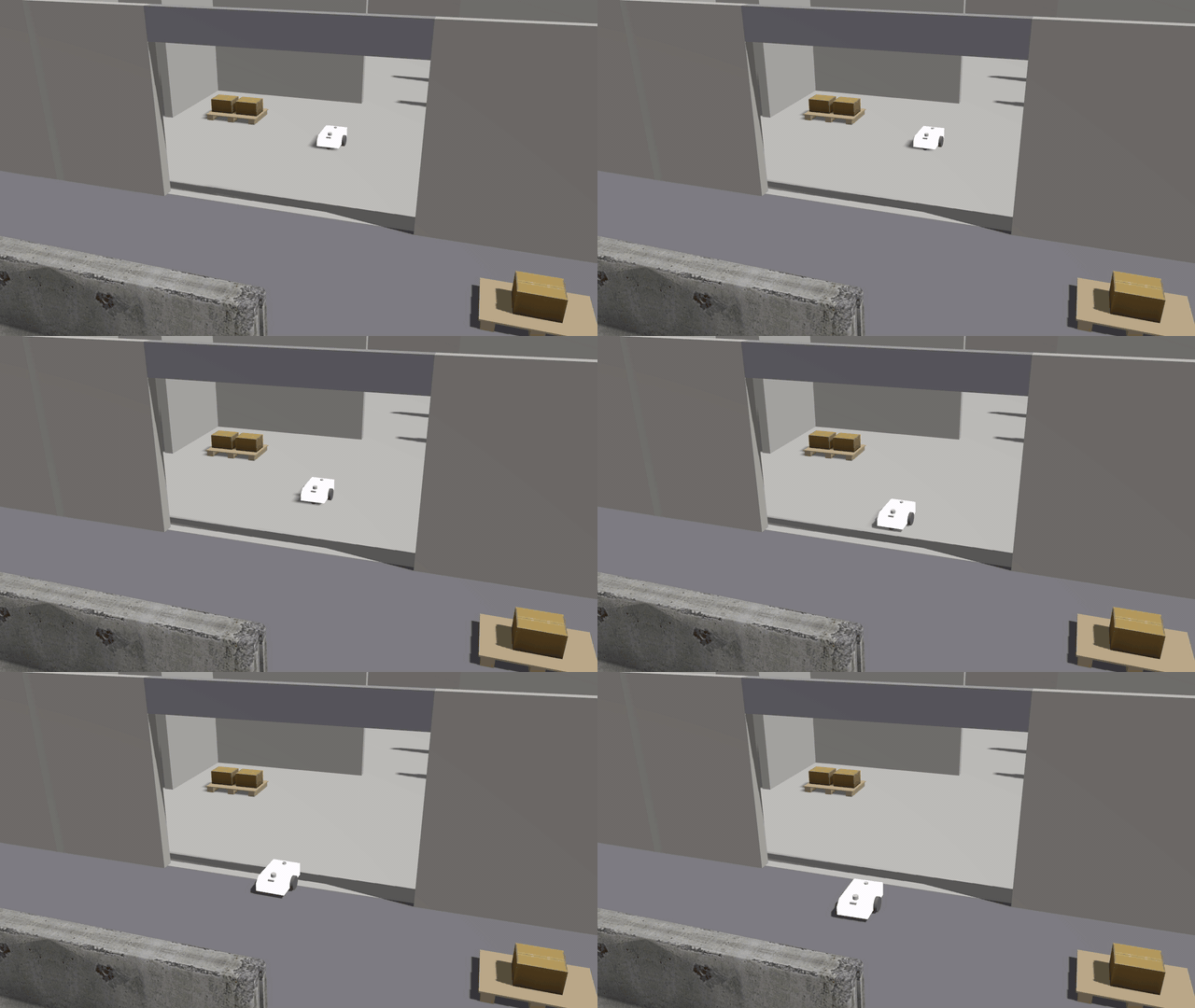
The first scenario as Fieldproof records it (the video output): the example UGV, running an unmodified Nav2 and SLAM Toolbox stack in its own container, drives from the loading dock through the roller door to a goal in the yard while five assertions check the run.
Quick start
On an Ubuntu 24.04 workstation with Docker (host setup):
git clone https://github.com/Dimitrios-Kafetzis/Fieldproof.git
cd Fieldproof
tools/host-setup.sh      # once: Docker, Node, uv, pre-commit (asks for sudo); log out and back in
examples/demo_m1.sh      # or: make demo
The demo pulls the published images, fetches the pinned Gazebo Fuel models, builds the example
vehicle image and runs fieldproof run examples/scenarios/ugv_nav_to_goal.yaml: the example UGV
(Nav2 and SLAM Toolbox, unmodified, in its own container) drives to a goal in the depot world
while five assertions check the run and its topics are recorded to
MCAP. It ends with PASS, the report, the video of the drive and the recording, which opens in
Foxglove Studio. The
same chain runs on every push to main in the Scenario tests
workflow. The scenario reference says how to write your own, the
vehicle manifest how to bring your own vehicle.
The core principle
The robot code never knows it is in Fieldproof. Only hardware driver nodes are swapped for simulated sensor sources publishing identical topics and message types, and the clock may be simulated. Perception, localisation, planning, control and mission logic run exactly as they do on the vehicle.
flowchart TB
    cockpit["L5 Cockpit (browser)<br/>React, Three.js, Foxglove WebSocket protocol"]
    engine["L4 Scenario engine (Python)<br/>schema, runner, events, assertions, reports, MCAP"]
    robot1["L3 Robot runtime<br/>real ROS 2 workspace in its own container"]
    robot2["L3 Robot runtime<br/>one container per vehicle"]
    bridge["L2 Bridge<br/>ros_gz and adapter nodes, topic contract per vehicle"]
    sim["L1 Physics and sensors<br/>Gazebo Harmonic, headless"]
    cockpit --> engine
    engine --> robot1
    engine --> robot2
    engine --> sim
    robot1 <--> bridge
    robot2 <--> bridge
    bridge <--> sim
Dependencies point downward only: the simulator knows nothing about scenarios, the robot code knows nothing about any of it. The architecture describes each layer.
Where to go
-
:material-map-outline: Plan
The overview (vision, principles, fidelity tiers), the architecture, the roadmap, the task backlog and the engineering standards.
-
:material-scale-balance: Decisions
The Architecture Decision Records: the engine, the ROS versions, the cockpit, the container model, the scenario format, the clock, the fidelity tiers, the repository and the languages.
-
:material-wrench-outline: Setup
Prepare a workstation, install the quality gates, build and run the container images, find your way around the workspaces, and read how CI/CD and this site are produced.
-
:material-book-open-variant: Reference
Reference pages for the CLI, the scenario schema, events, assertions and vehicle manifests, generated from the schemas as the engine takes shape.
How the project is built
One backlog task per working session, following the working model
and the session guide. Code, tests and documentation ship in the same
pull request, squash-merged to main with a Conventional Commit title, and this site is rebuilt
from docs/ on every merge.
The source is on GitHub at Dimitrios-Kafetzis/Fieldproof under the Apache-2.0 licence.