Worlds
The worlds Fieldproof ships live in the fieldproof_worlds package of the sim/ workspace
(workspaces.md), as SDF 1.11
files under worlds/, with the package's own primitive models under models/ and the Gazebo
Fuel models they include pinned in assets/fuel.lock
(01-architecture.md). Every world
loads the same systems, so any reference vehicle spawns into any of them: Physics,
UserCommands, SceneBroadcaster, Contact, Sensors (ogre2, headless rendering), Imu and NavSat
with WGS84 spherical coordinates (an arbitrary origin on the Athens coast, ENU), WindEffects
(the wind a scenario sets acts on the links that enable it) and Fieldproof's own
fieldproof::WorldEvents (the world events plugin).
| World | Task | Contents |
|---|---|---|
fieldproof_empty.sdf |
P0-T07 | ground plane and sun; the spawn tests of the reference vehicles use it |
depot.sdf |
P1-T02 | the navigation course below: a depot building with rooms, a corridor and racking aisles, and a yard with a ramp |
| marine worlds | P5-T03 | harbour with waves, wind and current |
Physics step and real time
Every world fixes max_step_size at 1 ms and real_time_factor at 1.0. The step is
the one the reference vehicles were tuned with (IMU at 100 Hz, DiffDrive odometry at 50 Hz, a
camera at 15 Hz, all integer multiples of it), and it is checked by test_worlds.py. The
real-time factor in the file is the default of a world started by hand; the scenario runner
sets the target per the scenario's time mode (ADR-0006)
through the /world/<name>/set_physics service, which is also how the world test lifts the cap
to measure what the machine sustains.
What limits the real-time factor is physics, not rendering. Measured on the reference
workstation (Ryzen AI 7 PRO 350, Radeon 860M through /dev/dri), the depot without a robot ran
uncapped at a real-time factor of 3.1 with primitive collisions only, while the first draft with
two Fuel models whose collision is a mesh (a pallet and a traffic cone, static, resting on the
ground plane) reached 0.54, and 0.32 with dynamic boxes on the mesh pallets. In gz-physics a
mesh against the ground plane costs a large share of every step, so no model in a Fieldproof
world has a mesh collision: Fuel models are chosen for box or cylinder collisions, and the
pallet and traffic cone are primitive models of this package. test_worlds.py fails when a
mesh collision appears in a world or an installed model.
depot: rooms, corridors, obstacles and a slope
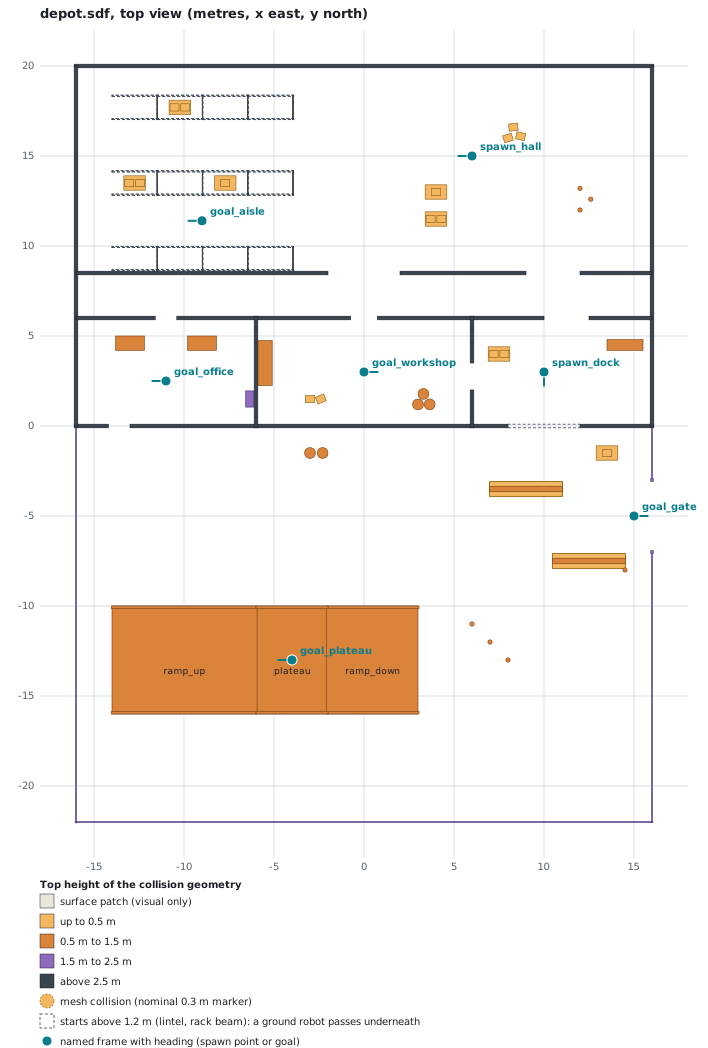
The map is generated from the world file by scripts/world_map.py (collision footprints,
coloured by top height; dashed outlines start above 0.5 m, so a robot passes underneath) and
checked for currency by test_worlds.py; regenerate it after editing the world with
sim/fieldproof_worlds/scripts/world_map.py worlds/depot.sdf -o ../../docs/reference/worlds/depot-map.svg
after make assets.
Coordinates are metres, x east, y north. The building (x −16..16, y 0..20) has 0.2 m walls, 3 m high, and no roof, so the sun lights every room and the camera sees indoors; the yard (y −22..0) is fenced 1.8 m high with a 4 m gate on the east side.
| Area | Extent | What is there |
|---|---|---|
| Hall | x −16..16, y 8.5..20 | three rows of four pallet_rack_section (2.5 m × 1.4 m × 3 m) at y 9.3, 13.5 and 17.7 with 2.8 m clear aisles; pallets with boxes in the bays and on the floor; three traffic cones around a wet patch; loose boxes |
| Corridor | x −16..16, y 6..8.5 | 2.5 m wide; opens into the hall at x −2..2 (4 m) and x 9..12 (3 m) |
| Office | x −16..−6, y 0..6 | two desks and a cabinet; door to the corridor at x −11.6..−10.4 (1.2 m); pedestrian door to the yard at x −14.2..−13 |
| Workshop | x −6..6, y 0..6 | a bench along the west wall, three drums, two loose boxes; door to the corridor at x −0.75..0.75 (1.5 m); door to the loading bay at x 6, y 2..3.5 |
| Loading bay | x 6..16, y 0..6 | counter, pallet with boxes; roller door to the yard at x 8..12 (4 m, lintel at 2.5 m); opening to the corridor at x 10..12.5 |
| Yard | x −16..16, y −22..0 | asphalt; the slope; two jersey barriers (4.1 m) as a chicane in front of the gate; cones; drums and a pallet along the building |
| Slope | x −14..3, y −16..−10 | 8 m ramp up at 10 % (x −14..−6), 4 m plateau 0.8 m high, 5 m ramp down at 16 % (x −2..3); 0.35 m kerbs on both edges |
Spawn points and goals
The world declares named frames (<frame name="..."> at world level) for the poses scenarios
refer to. base_link of the UGV sits 0.12 m above the surface, so a spawn adds that to z.
| Frame | Pose (x y z yaw) | Use |
|---|---|---|
spawn_dock |
10 3 0 −π/2 | in the loading bay, facing the roller door; the world test spawns here |
spawn_hall |
6 15 0 π | in the hall, facing the racking aisles |
goal_office |
−11 2.5 0 π | through the corridor and the office door |
goal_workshop |
0 3 0 0 | past the drums and loose boxes |
goal_aisle |
−9 11.4 0 π | inside the first racking aisle |
goal_plateau |
−4 −13 0.8 π | on top of the ramp |
goal_gate |
15 −5 0 0 | through the chicane, at the yard gate |
Spawn the UGV into the depot by hand with the server running (make up starts it; inside the
dev container gz sim -s -r --headless-rendering depot.sdf does the same once sim/install is
sourced):
Models
| Model | Source | Collision | Licence |
|---|---|---|---|
pallet_rack_section |
Fuel, OpenRobotics Pallet_Rack_Section v1 |
boxes | CC-BY-4.0 |
cardboard_box |
Fuel, OpenRobotics Cardboard box v3 |
box (dynamic: a robot can push it) | CC0-1.0 |
jersey_barrier |
Fuel, OpenRobotics Jersey Barrier v6 |
boxes | CC0-1.0 |
55gal_drum |
Fuel, OpenRobotics 55gal_Drum v1 |
cylinder | CC-BY-4.0 |
pallet |
fieldproof_worlds/models/pallet |
box (1.2 m × 0.8 m × 0.144 m) | Apache-2.0 |
traffic_cone |
fieldproof_worlds/models/traffic_cone |
cylinder (0.7 m high) | Apache-2.0 |
Everything else (ground, floors, walls, fixtures, fence, slope) is primitives in the world
file. Fuel and package models are included as model://<dir>; both kinds are installed under
share/fieldproof_worlds/models, which the package's environment hook puts on
GZ_SIM_RESOURCE_PATH next to share/fieldproof_worlds/worlds.
The spectator camera
The depot carries one fixed camera sensor, spectator (model spectator_camera, in the yard
at (12.5, −7, 4) looking down at the roller door from the south-east, above the chicane),
framing the loading bay behind the door, spawn_dock and the yard in front of it: the course
of the first scenario. It renders 1280 × 720 at 15 Hz (a 1.0 rad lens), and only while Gazebo's
CameraVideoRecorder system attached to it is recording: idle, it has no subscriber and
renders nothing, so it costs the world tests and every run without outputs.video nothing;
recording, it roughly halves the simulator's real-time factor on a GPU workstation
(scenarios.md). The runner starts and stops the recorder through its
service /spectator/record_video and copies the MP4 into the run directory
(scenarios.md). Another world offers the same by declaring a camera
sensor with the plugin and a <service> of /<sensor name>/record_video.
The world events plugin
fieldproof::WorldEvents (sim/fieldproof_gz_plugins, library fieldproof_world_events,
task P2-T03) is the system through which a scenario's timeline changes a world while it runs
(events.md). Attached to a world, it advertises four gz-transport
services under /world/<name>/fieldproof/:
| Service | Request | Effect |
|---|---|---|
spawn |
gz.msgs.EntityFactory (sdf or sdf_filename, name, pose, allow_renaming) |
create the model at the pose, under the given name (refused when the name is taken, unless renaming is allowed: crate_0, crate_1, ...; refused when the SDF does not parse or holds no model) |
remove |
gz.msgs.Entity (name) |
remove the model of the world called so (refused when there is none) |
teleport |
gz.msgs.Pose (name, position, orientation; no orientation means none) |
move the model there at once (its velocities are kept) |
set_wind |
gz.msgs.Wind (linear_velocity, enable_wind) |
set the world's wind entity (seed and velocity) and tell WindEffects, which pushes the links that enable wind and answers /world/<name>/wind_info |
Every request is queued by the service thread and applied against the entity component manager
in the next PreUpdate, the only place a system may change it; the reply, a gz.msgs.StringMsg,
comes once it has been applied: a one-line report (spawned model crate at (10, 0.8, 0.25, yaw
0)) or error: ... with the reason. Gazebo's own UserCommands system answers its create,
remove and set_pose requests when they are queued (its /blocking variants wait, but answer a
bare Boolean), so a client learns neither whether a request was valid nor what happened; the
scenario engine needs both, since an entry ends ok or failed on the answer and the next entry
or an assertion window may depend on the world having changed.
sdf="<?xml version='1.0'?><sdf version='1.11'><model name='crate'><static>true</static>"
sdf+="<link name='l'><collision name='c'><geometry><box><size>0.6 0.6 0.5</size></box>"
sdf+="</geometry></collision></link></model></sdf>"
gz service -s /world/depot/fieldproof/spawn --reqtype gz.msgs.EntityFactory \
    --reptype gz.msgs.StringMsg --timeout 5000 \
    --req "name: \"crate\" sdf: \"$sdf\" pose { position { x: 10 y: 0.8 z: 0.25 } }"
gz service -s /world/depot/fieldproof/set_wind --reqtype gz.msgs.Wind --reptype gz.msgs.StringMsg \
    --timeout 5000 --req 'enable_wind: true linear_velocity { x: 4 }'
The simulation image builds the package into /opt/fieldproof_sim and points
GZ_SIM_SYSTEM_PLUGIN_PATH at its lib (containers.md); the dev
container finds it through the sourced install space of sim/. test_world_events.cpp (a gtest
on gz::sim::TestFixture, make test-ros) runs a headless server with physics and WindEffects
and calls every service through gz-transport: the pose of a spawned box, a name taken and
renamed, bad SDF, a teleport with and without an orientation, a removal and a second one, the
wind seed and wind_info; test_worlds.py requires the plugin in every world.
The asset pipeline
Assets follow the convention of assets/README.md:
vendored files live under assets/ with a licence file in assets/LICENSES/, and Gazebo Fuel
models are not vendored but pinned.
assets/fuel.lock records, per model, the Fuel owner and name, the version, the directory name
on the resource path, the SPDX licence (permissive only: CC0, CC-BY, Apache, MIT; no NC or ND
terms), the archive size and its SHA-256, and the worlds that use it.
tools/assets/fetch_fuel.py (standard library plus PyYAML, like the other host helpers):
| Command | Effect |
|---|---|
make assets (fetch_fuel.py) |
download the archives missing from assets/fuel/archives, refuse any whose digest differs from the lock, extract each into assets/fuel/models/<dir> with a stamp; a no-op when everything is in place, so it needs no network once cached |
fetch_fuel.py check |
verify offline that every archive and model directory matches the lock (exit 1 otherwise) |
fetch_fuel.py add OWNER/NAME --used-by depot |
pin a model: read its metadata and latest version from Fuel (--version N for another), download, record the digest and licence, extract |
assets/fuel/ is ignored by git. The fieldproof_worlds build runs the fetch (so a fresh
clone's make test-ros works, with network on the first build), installs the models, and
gz sdf --check resolves the includes through SDF_PATH. make up runs the fetch too, and the
compose sim service bind-mounts assets/fuel/models with the worlds and the robot models
(containers.md). CI caches
assets/fuel/archives keyed on the lock, and tests/assets/test_assets.sh (make test-assets)
exercises the script against a local stand-in server: fetch, no-op, offline check, a tampered
archive refused, re-extraction from the cache, an archive entry escaping its directory refused.
Tests
| Test | Target | Checks |
|---|---|---|
sdf_check_<world>, sdf_check_model_<model> |
make test-ros |
gz sdf --check on every world (with the Fuel and package models on SDF_PATH) and every package model |
test_worlds (pytest) |
make test-ros |
physics step and systems of every world; every include pinned or local, installed and stamped; no mesh collision; the depot's frames, rooms, racks and slope; the map is current |
tests/worlds/test_depot.py |
make test-worlds |
the P1-T02 verification: the depot loads with every model within FIELDPROOF_WORLD_LOAD_LIMIT_S (10 s), the UGV spawns at spawn_dock and its lidar, IMU, camera and odometry publish, the uncapped real-time factor over 30 simulated seconds is at least FIELDPROOF_WORLD_RTF_MIN (1.0), and the server resolved every resource |
tests/assets/test_assets.sh |
make test-assets |
the asset convention, the lock and the fetch script |
make test-worlds runs in the dev container with the sim and robots install spaces
sourced (tools/ros/colcon.sh run), in a private Gazebo partition and ROS domain. On the
reference workstation the depot loads in about 2 s and runs at a real-time factor of about 2.6
with the UGV and all its sensors; CI runs the same test with software rendering and relaxed
limits (FIELDPROOF_WORLD_RTF_MIN=0), where it checks loading and resource resolution and
prints the factor it reached.